Friday, January 14, 2011

Cat Ruka's opening to the Dudley Benson Show - By Val Smith


(Val Smith is a New Zealand/US dance artist engaging with the fields of education, performance and research, her work interfacing with a sensation-based, creative practice. Her performance background is in contemporary dance, improvisation, feminist performance art, and political street theatre, since 1991).


I saw the final show at Oratia Settlers Hall on a warm Sunday evening (December 5th 2010).

We arrive by car from the city.
I am aware we are much closer to the Waitakere Ranges.
I can smell flowers and trees in the air.
As we walk across the road to the hall I become aware of birds calls, Ruru.
It feels really alive here in a very different way from where we have just come from.
This feeling of aliveness is also filling the hall as we enter to find seats.
People are excited in a quiet, sparkly-eyed kind of a way.
Having never seen Dudley live before I don’t really know that which is happening.
The hall slowly packs, and more chairs are pulled out to accommodate everyone.

Cat’s piece opens the show and is rendered like a kinesthetically communicated karanga. She stands as a solo artist on the small raised stage, but I easily sense all the other performers are with her, just not yet seen. Lit with DIY lighting, the space is all really old school colonial styles, all tea cups and dance halls. Calling across thresholds with precise and refined signals, becomings, and embodiments, Cat skillfully crafts the focus and quality of mind/spirit in the Settlers Hall.

The piece functions to set the tone and intention for the whole event, and in her role Cat perhaps functions as our spiritual host. I really enjoy the formality of this ritual along with the way Cat manages to also undermine the formality with an inspired approach to content. Perhaps I should give an example of what I might mean by this here, in case you didn’t see this work, but hmmm, nah, maybe you can just imagine what a dissident and transgressive ritual choreography might look like…

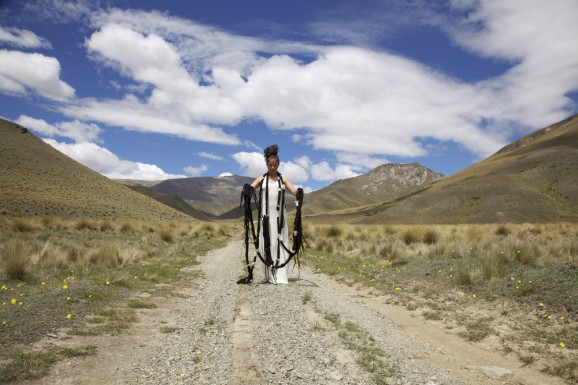
Body is dressed in a long simple off-white costume with a long black thick rope wound loosely around her neck, it is slowly cast off or birthed through, with slow weaving hands and arms, then, it just lay there evocatively draped across and around her feet. At some point, I cant quite remember when, Cat seats herself on this chair, knees spread wide in a strong position claiming spaces of all kinds, including sexual spaces, and its like, here I am, whatcha gonna do, but softer and more intricate than that. I drop into the liminal flow of images, engagements with audience, and all of the ancestral, modernity, and contemporary referencing.

There is a part where a stream of quick edits of breathing movements morph in quite a trippy way. I am struck by how easily Cat moves between embodiments of the feminine and masculine. In split second shifts she becomes a god, a warrior, then perhaps an ancestor, and long gone early modernist choreographers. All and more inhabit the choreography - ghosting characterisation. I really super love this part. She is pushing around binaries - I see the spiritual and physical, tapu and noa, and feminine and masculine realms being cleverly played.

Not only a maori invocation/ritual, this work also plays out as a protest piece. Owning ‘self’ as maori and a performance artist Cat opens up (and closes) emotional realms and fields of qualities through ways of being, through carrying her history and allowing us to see all of it. She somehow invokes and includes past, present, and future social and political paradigms, challenging all of our colonialist fuckups, and provoking ‘us’ (the implied us-ness of an audience, as visitors on the implied marae) to stand up and own our ‘selves’ as well. This is mostly all implied, so I’m not sure how to explain this with concrete descriptions.

There is a definite flavour of subversion to this work, (as there is in all of Cat’s artistic work to date), but in this case she is pointing partly at a lineage of modern dance and the interest in primitivism at the time, making movement references to that dance history through the lens of colonisation of the exotic body. Her statements are intriguing through their complexity and ambiguity. Notions of the spiritual are at once revered and questioned. It’s really intelligent, but also emotional. It’s like I’m not exactly sure what is happening but there is a sense of the mystique of ritual and quite rightly so I’m drawn into the magic of it and the artistry of how she is revealing the realm of spirituality and politics combined.

Cat has a strong sense of mana as a performer that is very moving. Through this particular performance she is making bold statements about gendering possibilities through incarnations of maori masculine and feminine symbols and movements which she unapologetically owns. There is a feeling of pushing boundaries around what is ‘ok’ to portray here, but she is totally confident in her decisions, so I feel like she is creating new ideological grounds that others can walk upon too. What she challenges she changes. I experience an empathic exchange of hope and courage whereby she is envisaging a future more tolerant of living diversity.

I bring diversity into the discussion deliberately here, because this performance is making statements about what it means to be maori, a woman, a dancer, and a performance artist. But beyond this Cat is also creating ideological space for the performance of Dudley and The Dawn Chorus and all of the implied statements of that segue into our experience as audience - that of witnessing living sexuality, sexual identity, queering, and genderqueering.

Cat’s performance opens a door for understanding and appreciating the significance of Dudley Benson as a living history of contemporary performance practice and self conceptualization. For me, Dudley embodies a lineage of fighting for the freedom to express a queered self acceptance in art. Whilst how he is in himself signals for me a time where we can more comfortably and visibly be who we are in performance and art, there is still a reminder of a history of violence against LGBTQ communities. The witnessing of Dudley and The Dawn Chorus doing their thing sheds light on meanings evoked by Cat’s work. There is a revealing of the subtleties of what she is communicating to us through contextualisation of what comes after her. I realize more of her gendering intentions after I ‘get’ the extent of what Dudley and his art practice represents.

This set is a collection of Dudley’s interpretations of waiata by the New Zealand composer Hirini Melbourne. They are folksongs that celebrate Aotearoa’s birdlife from Dudley’s new album Forest: Songs by Hirini Melbourne as well as songs from his debut album The Awakening. Dudley and The Dawn Chorus are sweet and concentrated, carrying us into a kind of quasi-religious state. We are reflective and transfixed by their delicate and articulate voice and song. I think Dudley might come from a church choir background, but whether he does or not, I am taken into a heightened space that sparks feelings that I associate with churchly experiences. Why is this worth a mention? Because Dudley is mixing queering with God, and that for me is such a very valuable actioning in these present times.

I know now the meaning of the sparkly eyed thing I saw in people as we entered the space tonight, Dudley is well loved. Its so interesting to me how I feel affirmed in my own queering identity by just witnessing Dudley’s presence in performance…but the strength of talent of his artistry along with the talents of Hopey One (beatbox) and the rest of The Dawn Chorus members is just so damn beautiful, I end up crying quietly throughout their set. Tears for injustices, tears of shame and pain, tears for loves, and loves lost and left. What I carry away from Cat’s performance and this event as a whole is a renewed hope and gratitude for the living and loving of queer and genderqueer artists working away all over the place dreaming and enacting new futures and worlds.

http://dudleybenson.com
http://catruka.com/

Sunday, September 5, 2010

CINDERELLA - By Ann Liv Young. Reviewed by Cat Ruka

As I enter the building an old naked man in womens’ make-up stands at the top of the stairs leading to the theatre. He is saggy and creviced, a confrontational image of everything about the body that society passionately seeks to avoid. I won't pretend that initially I am shocked and caught off guard by the honesty of this, but given the nature of the work I am about to see, I assume that he is part of the cast placed intentionally amongst audience members to help jolt us out of the normality of our lives - or perhaps for any other reason - maybe just for fun. I give the man a warm hello, which he receives gratefully and politely, and then I take my place in the long line for tickets. I soon see however that he is standing a few people behind me waiting in line to be ticketed just as I am. This not only reminds me that I am in New York, but also sets the tone for an event that has already, without even trying to, immediately confused the traditional boundary between audience and performer.

The venue that Naked Man and I are lining up outside of is Issue Project Room, located on the third floor of the Old American Can Factory in Gowanus, Brooklyn. It is a long white rectangular venue with no ‘stage’ area as such, meaning that the performance takes place amongst and with the audience. Upon entering the space, which has been decorated with huge bunches of balloons and blow-up animals, we all circle ourselves around an orange square in the middle of the room, which has on it, among other random objects, a laptop, some papers with notes on them, a microphone and stands, water bottles, food, and what seems like beads or gems scattered around. The style is colourful, kitschy and primitive, as though we have entered the earnest pages of a young girl’s scrap-book. There is a woman standing at the end of the room overly primped in a blue hooped princess dress, white gloves, thick garish make-up and a blonde wig topped off with a small sparkling tiara. Beside her are two male assistants in black suits, pink bow-ties and wigs, and a soundman in a bloody-stained blue lycra dress stands by the mixing desk near the middle. When everyone is in, the woman makes her grand entrance to the middle of the room on roller-skates, floating toward her fantasy.

The woman on wheels is none other than controversial, provocative and prolific New York based performance artist Ann Liv Young, a young woman who since graduating from Hollins University’s prestigious dance programme has fast become a leader in her field. At only 29 years of age Young has performed her distinctive works at some of the world’s most leading festivals and venues including P.S 1 Contemporary Art Center, Brooklyn Museum, The Kitchen, Dance Theater Workshop, P.S 122, Judson Church, Impulstanz, Tanz Im August, Springdance, and Laban Centre London, among others. Having only had the chance to follow the woman’s prowess via her online presence (which is quite extensive by the way), my anticipation is running high. What will I see tonight in this sickly-sweet room? Will I see boobies? Will I see people having sex? Will someone even try and have sex with me maybe?

Starring in Young's one-woman fairy tale reinterpretation is her own alter-ego “Sherry”, an aggressive and persuasive southern wildcat who in turn plays the character of Cinderella, a poor young maid whose parents are dead and whose evil step-sisters control her meaningless life. Essentially there are three women performing tonight, each one bouncing in and out of the aggressive and the demure, an interplay that manages to investigate female archetypes and stereotypes without boring you to death with serious feminism. The juxtaposition of a socially provocative character (Sherry) inside a strangely sweet and child-like veneer (Cinderella) is a subtly tense yet playful dynamic that among other things, enables the audience to maintain curiosity.

Existential ‘Dear Diary’ monologues that Cinderella softly recites into the microphone as she sits in front of her laptop provide a simple thread through the first part of the performance. These personal and almost shy offerings are spliced and contrasted with her trademark use of pop songs, which she leaves her computer to dance and rap/sing along to with conviction and a truthful attempt to get the words and pitch correct. Her two suited assistants in pink bow-ties and wigs provide flamboyant back-up dancing with flashing fame style moves. High kicks, turns, and pirouettes never looked so funny, must have been the wigs. A favourite moment is Young’s powerful and hilarious rendition of T.I’s Whatever You Like, which she manages to re-contextualize with a Riot Grrrl attack on the microphone.

It is a simple structure that unfolds. Young performs a song or monologue, and then addresses the audience with questions, after which she returns to her computer to recite a monologue again. It soon becomes apparent that it is not the actual singing and dancing and 'performing' that is the 'performance', but rather everything else that happens in-between it. She gets on the mic and asks us how we are, what we think of the performance, if we have any questions or comments. The young intellectual Brooklyn audience is keen to participate, giving responses that Young steers the show with by cleverly throwing it all back in our faces. The issue of relationships and being in love comes up at some point, which then becomes the over-arching theme of the rest of the discussion, paralleling the story of Cinderella. Young spots a man alone leaning against the wall, whose name is later revealed to be Jacob. She interrogates him about his relationship history, which he reveals to be almost non-existent. She proceeds to ask him very personal questions and the air becomes awkward and tense. She takes him outside to ask him further personal questions, which she then shares with the audience when they return. “Jacob hasn’t had sex since 2003" she says, embarassing him as anyone naturally would be in this situation, and it seems as though he is on the brink of tears, crushed like a young child who learns that their favourite storybook character is not real.

Young’s behaviour seems a little unfair to me at this point, and to me it is though she has crossed a certain line. I feel compassion for Jacob and a hint of resentment towards Young, a resentment that probably comes from the same place as the anger that has lead people to physically attack her in previous performances. I sit there petrified at the possibility that I may be the next victim of her terrifyingly direct questioning. But as the evening progresses, my resentment transforms into complete awe as I come to understand her embarrassing provocations as cleverly crafted acts of healing.

After performing another song, Young lifts her dress up, pulls down her stockings, and squats on top of a bowl announcing that she is going to poo into it (she also happens to be eating something at the same time I might add). She sits there pushing, asking us to look away whilst she performs this act, but then asking us to gather around closer to her, which she suggests might actually help her push the poo out as it proves difficult to do. Stage fright perhaps. She asks us for advice as to what might help her shit which, by the way, she innocently refers to as "doo doo." Someone hands her a cigarette, the soundman opens a coke for her to drink, a friend from the audience even gets up and sticks two fingers up her arsehole in an attempt to douche it out. Nothing works though, so we sit back down and she changes the subject.

What was supposed to be approximately a one hour performance turns into a 3 and a half hour ritual. It emerges as an open forum discussion, where Young in fact recognizes that people may receive her as a controlling protagonist that uses the misfortunes of other people to create entertainment. We sit on the floor huddled around her like primary school kids, listening intently to the mistress share her glittering story. She addresses Jacob again, who throughout the evening has become the star of the show in a way, perhaps identified by Young as someone who was looking for some help in the first place? Maybe not though, who knows. She actually ends up making out with him, and then after this, repeatedly asks him if he wants her to give him a blowjob, maybe to show him what he really wants, maybe to just do it. Ironically, Cinderella has found her prince, but it is she who saves him in this instance, a clever twist and maybe an accurate reflection of the power that women do actually have over men. There is no clear ending to the show and we are all finding it hard to leave, partly because as audience members we aren't given an obvious "THE END" cue which we are all so used to. The curtain to this fairytale never drops, and we are forced to enter back into the worlds we came from with a lingering sense of "FOREVER AND EVER." Young asks us, "Why haven't you all left yet?" And we all kind of look at each other with "Who the hell knows, I just can't!" expressions on our faces.

Just over 24 hours have past and I haven’t been able to get Ann Liv Young/Sherry/Cinderella - or the chain of events that she provided the conditions for - out of my head. To me she is a sharmanistic provocateur disguised behind the annoying aggressive feminist stereotype, perhaps a completely selfless act to come off as the bad guy whilst all the while undertaking the work of a modern-day spiritual doctor. Ann Liv Young can simultaneously create excrutiating discomfort, unusually profound enlightenment, humour and grief. Exposing people to their own potential, to their true identities and to what is stopping them, Ann Liv Young is an inspiration to those of us performers who want to transform our audience. Behind the candy-dipped facade of an old story she is simply seeking for honesty I think, in her own performance delivery and in her community, because if we are honest with ourselves, and are honest about ourselves in the presence of others, can we perhaps heal and let go of that which brings us misery and holds us back from our potential? I feel privileged to have witnessed Ann Liv Young’s idiosyncratic take on the fairytale of Cinderella, and to be making work and viewing dance at a time when she is around is, simply, inspiring.

And as for Naked Man, a personal thank you to you my friend for owning your body, your identity, and your true desires. May you shine on like the crazy diamond you are, and may you continue to lead the path for those of us who have become afraid.

Friday, July 16, 2010

MA SODA 'entry examination' UDK 2010 Writing exercise: Critique of another appilcant's solo: 'Flashdance' - By Alexa Wilson


Q: 'What did you see? How did it work? What was its wider frame of reference? What critical feedback do you have?'

I saw Bulut from Serbia, a tall woman with big black hair in a skant black leotard, perform the beginning of the audition routine from the 1983 movie 'Flashdance' just as it was done in the film to its hit song 'What a Feeling'. She performed it complete with making a mistake and asking to begin again, which she did twice before continuing to deconstruct the notion of an audition, 'art' and contemporary dance conventions as they currently stand in Europe through a monologue which parodied dance and herself as a performer.

To me the irony of her deconstruction was that satirical dance deconstruction itself is now a well utilised convention within contemporary choreography, originated by Pina Bausch in the 1980s and the likes of Jerome Bell in the 1990s. Therefore I presume that she was self-consciously playing upon cliches as such references to 'Flashdance' and the trend towards 1980s retro being 'hip', which has usurped the western world for the past 10-15years.

This solo was clever within its own conceptual framework and well performed by Bulut, taking the audience on an initially cringeful journey of cliche through an enticing and skillful presentation of theatrical piss-takes of various conventions within post-modern dance, which became demonstrative. These consisted of referencing 'using intuition' like a sniffer dog, 'internally motivated movements' which were basically hip hop moves, intellectualising herself within an existential paradigm of 'reflections', being 'out of control' and being 'smart, but not too smart' as well as 'pretentious'. It was entertaining and a strong piece, evidence of a quixotic and sharp mind and clever wit.

The journey of descent that the work took was into a neurotic, narcissistic, self-referencing set of mock 'confessions' and the work ended with her dancing to another of 'Flashdance's songs 'Maniac' and tossing herself clumsily around on the floor with limbs landing heavily before sneaking off the stage and out of sight before the music ended.

I thought it was particularly clever in summarising what this audition process for the MA SODA course is, which is an experimental, intellectual European dance version of 'Flashdance'. She referenced not only this film's cult status to ironically 'express' the way that dance essentially can no longer because it is seemingly in the grips of serious intellectualism and physical minimalism, but to deconstruct the intensity of the conventional audition process itself, which is the part of this film that her dance referenced. This film is very 'hip' right now.

My main criticism of this work is along the lines of my current questioning about post-modern dance in general. Satire is now an institution within contemporary dance and so is speaking through an entire 'dance'. Dance has long since been the 'new theatre' in Europe. With all her skills, performance talents and well crafted ideas, perhaps Bulut could turn her attentions to deconstructing something beyond dance itself, such as any number of pressing issues in the world right now. This not only risks more personal exposure as an artist but contributes something to the world at a time when it is actually in crisis. It is also safe and no longer boundary pushing when something becomes a trend as it is afraid to actually say something which has genuine risk involved.

Deconstruction is very important to any art form in questioning power structures and humour can be powerful, but there are a few more interesting things that this performer could put these skills and talents to than entertaining the dance scene with self mockery. I also wonder, where to from here with self-referential deconstruction, which brings us to the surface? Does this actually unconsciously mirror the larger state of the world in not really knowing? In which case the post-modern theorists have won their case and a reflection of surfaces is all we now have- even inside such (self) bludgeoning artistic 'self-consciousness'.

By Alexa Wilson

Friday, June 18, 2010

Maybe Forever by Meg Stuart and Philip Gehmacher - Reviewed by Cat Ruka

Irregular flashes of light across the stage reveal an electric guitar, speaker and mic-stand to the right. There is a sense of loss and abandonment here, instruments incomplete without their players. A half-round curve of heavy blue-grey curtains provides an unusually shaped backdrop, which as the flashing fades to darkness and the light ever so slowly grows again, is revealed to be a wry suggestion of an empty small-town cabaret lounge. The huge image of two dandelions being blown in the wind stretched wide in front of the curtains echoes the sense of romantic wishing that tends to linger in such an environment. Two figures are positioned centre-stage, sitting side by side on the carpeted floor with legs stretched out and backs to the audience. Slowly they recline in unison until lying submerged in their world, and as the man apprehensively stretches his arm out to grab the woman’s, their intimate interplay begins.

Awkward engagement and disengagement is at the core of this restless folding and unfolding duet. Man and woman dressed in every-day clothing roll and struggle across the floor, stopping every now and then for long periods, finding it difficult to make prolonged physical connection. The choreography has been given all the time and space it needs, allowing the work’s message to gradually and undetectably seep into the hearts of its audience like love-sickness. Penetrating insight into the nature of a steady declining relationship is delivered through the movement’s calculated clumsiness, which in its disregard of the balletic code provides an astonishing unpredictability.

The man and woman stirring uncomfortably in each other’s presence are Europe-based choreographers Meg Stuart and Philip Gehmacher. In 2007 the two came together in collaboration to create Maybe Forever, which has been touring the world ever since and is performed as part of the main performance program of the 10th Indonesian Dance Festival in Jakarta. Although both very different in their approach to choreography, space and design, the two arrive at a complimentary meeting place that, unlike the disintegrating relationship they demonstrate, has proven to be a winning point of departure.

Stuart and Germacher are joined by Brussels-based singer/songwriter Niko Hafkenschield, whose shiny blue lounge jacket surreptitiously reinforces the tired pub-like environment. His sweetly melancholic series of love ballards infuse the dancing with a fragile and delicate darkness. Quite indie-blues and up-to-date in its retro character, Hafkenschield’s performance contextualizes the story of love in a contemporary setting, helping to transform age-old issues into radically progressive performance. With his soft and vulnerable lilting he is a modern day angel of sadness - honest and open, almost unbearably so, in that he demands us to be honest with ourselves.

Stuart performs two text-based solos in the work spliced with abstract gestural arm movements, each solo positioned at either end of the stage. The first she performs in a skirt and heels, both rather drab and forgettable in colour, the skirt at an awkward just-below-the-knee length. She also wears a restrictive dark leather or vinyl jacket, completing a rather incoherently assembled outfit. The loud squeaking and crunching of the jacket amplified by the microphone emphasizes the ongoing feeling of unease, of everything being not quite right. Interrupted by gestures and silences that drag her away from the microphone, her text is broken and incomplete. Right down to the very last detail, this work is a tour-de-force of struggle.

Gehmacher’s solo is performed in his signature style of timid apprehension towards space. Shoulders inelegantly reaching for the ears and gawky transfers of weight as he walks from one position to the next create an uncoordinated language of movement that speaks volumes for the uncoordinated relationship he is in. It is almost as though he is embarrassed, self-conscious of the fact that there are people watching him. He pulls back the curtains and reveals part of the backstage area. Stuart enters and together they perform a phrase of ‘almost-hugging’, difficultly manoeuvring around each other, he often failing to complete the touch. The cold black concrete of the theatre’s walls are exposed and so too is a cold and dying union.

The startling final act of the work plays out like a Lynchian memorial service, spooky enough to send shivers down my spine as I sit in disbelief. In a bright yellow shirt and black jacket and trousers, Gehmacher performs a final confession to the one he has lost – he moves abstractly around centre stage and as he does so, a recorded speech is laid over the top, the text broken up and slightly nonsensical. Without warning Stuart enters from the right in an intensely garish orange sequined dress, slinky and shimmering under the lights. We are caught off guard by this over-excited outfit, which after the previous dowdy and monotonous clothing makes a raucous and unsettling statement. She takes a seat next to the musician’s speaker. He enters and stands behind her as if to claim her as his. Almost menacingly she simply sits and watches, looking ridiculously fabulous and no longer Gehmacher’s who is now out of his depth in this uncomfortable situation. And with a painstakingly slow lighting fade, the image is crystallized.

After seeing Maybe Forever I dreamt that I was having a conversation with the woman an ex-boyfriend of mine is seeing. She was crying hysterically, trying to make sense of their crumbling connection, demanding that I give her insight whilst simultaneously refusing to accept any advice I offered. For some reason this was all taking place on the sports field at my old primary school, an aptly surreal continuation of Stuart and Gehmacher’s performance which somehow managed to bleed further into my consciousness than I had hoped. Obviously this work affected me profoundly and like the memories of failed relationships will continue to stay with me, maybe forever.

Contact Gonzo by Contact Gonzo - Reviewed by Cat Ruka


Four young Japanese men casually enter onto the stage while the house lights are up. They are wearing t-shirts and track-pants and still have their performance passes on around their necks. One is carrying a backpack, others have water bottles, and there is a video camera on a tripod. They could well be mistaken as backstage helpers preparing the stage for the next act, but as they empty their pockets, place their objects on the ground and begin to warm up, it becomes clear that they are not ‘helpers’ at all.

For a few minutes the men pace around, lunging and stretching their arms out every now and then, not in a dancerly fashion but as though they are about to run a 100m sprint. They seem to be preparing themselves both physically and mentally, creating suspense and tension in their audience, who are all probably wondering what the heck is going on.

Eventually two of the men make contact, not in the sense of contact improvisation where physical connection is utilized to explore movement, but rather within a code of combat or struggle. They push and tussle, climbing on top of one another, every now and then dropping away to reposition and grab a drink of water or to take a photo on their disposable camera. Gradually the battling begins to escalate and without warning one of the men strikes another in the face, the sound of palm to skin cutting through the air and triggering surprised gasps of horror from the audience. This surprise is pushed even further as suddenly from behind a backlit cyclorama a drummer begins a wild improvisational solo. Crashing and banging and wildly attacking the drum-kit, a huge ominous shadow of this female performer showing her drum-kit who’s boss is an interesting backdrop to the male brawn on stage.

The every-day pedestrian paradigm coupled with the invitation to raw violence set up by these performers instils an immediate sense of unconventionality. Contact Gonzo take their name from the rebellious style of ‘Gonzo’ journalism made famous by American journalist Hunter S. Thompson. The exposing of what is normally hidden from an audience such as the warming up, the training clothes and the replenishing of oneself with a drink of water runs parallel to the raw and un-edited subjectivity of the Gonzo style of writing, in which grit is favoured over polish. Thompson would also document a lot of his own actions whilst he was immersed in journalistic projects, a reflexive technique also realized in Contact Gonzo’s use of video and stills cameras on stage.

As the men continue to grapple with each other, a cell-phone rings in the audience. As we know, the rules of theatre etiquette state that this is highly disrespectful and automatically garners negative reactions from audience members when it occurs. A group of people seated around the ringing cell-phone show their disgust with forceful shushing, which is then addressed by one of the performers who simply says to them, “No it’s okay. It’s okay.”

More violent slaps to the face are thrown from every which direction, more piles of bodies rise, tumble and loudly crash to the floor. A modern urban realization of traditional sumo-wrestlers at times, Contact Gonzo continue to battle away with themselves. And for what reason? Does it all just come off as highly charged testosterone gratuitously taking advantage of the theatre space to flex a bit of muscle? There is no emotional narrative here to suggest the reasons behind their fighting. They just are.

To me it is no surprise that this young team of performers are currently being invited to perform this work in festivals all over the world, which comes off more as an uncontrollable event rather than a finely-crafted performance piece. It is clear however that this group has a precise agenda, and their unique antics ensure that they stand out among the rest. Contact Gonzo is a highly innovative ‘dance’ company who unabashedly challenge the established norms of the theatre. Representative also of a contemporary consciousness in which violence and technology are implicit, I’m sure their work will act as an interesting reference point in critical dance discussions for years to come.

Darkness Poomba by Kim Jae Duk - Reviewed by Cat Ruka

Two male dancers ignite Darkness Poomba with a duet performed under severe top-light. A fast and furious exchange of angularly choreographed movement, hands mechanically grasping for each other’s faces, and bodies regimented in a forward facing stance. Creating the illusion of a robotic pair of Siamese twins, the two young men are a fashionable modern day fruition of an ancient cog-like machine. Five dancers clad in chic black clothing sharply enter from the peripheries to join the machine and expand upon the gothic energy that has been created.

A spot is brought up on a man standing with a microphone in one of the aisles. Both the ears and eyes are immediately drawn to this powerful presence and we are captivated as the space swells with his voice – he is chanting the traditional South Korean Poomba, scattering sounds of desperation and yearning. Sound manipulation gives an echoing reverberation as if to suggest that we are all inside a cold and mysterious vault of some sort, liminally suspended between hallucination and reality. The performer displays extraordinary command over his dexterous instrument, and his sensitive commitment to the dancers on stage help them to devote themselves to the dark abrasiveness of this space.

Later in the work, a dance with metallic dinner trays between the two male dancers who opened the piece brings an oddly domestic sensibility to the abstract world that has been established. The device of sound is again utilized in this instance, as dinner trays become percussive instruments as well as hats and items of clothing. The chorus of dancers behind them acts as a strata of strange shadows that morph from one contained image to the next. All ensemble dancers solidly support this duet and other highlighted moments of the work with crisp articulation of movement and un-wavering performance energy. It is as though they are there to tease out the dark underbelly of this work with a quiet ferociousness.

The darkness of this rich work is both deeply set into the bones of its body and ironically woven into its surface. Even when the whole theatre is clapping and singing in delight as they would at a concert of their favourite musician, the haunting atmosphere never lets up. In fact it is in these moments of ‘light’ that the gothic undertone is somehow heightened, demonstrating a sophisticated approach to the creation of atmosphere. Funereal organs and regular pumps on the smoke machine provide a parody that is both easing and unsettling for its viewer participants.

As one of the ensemble dancers leaves the stage to join the vocalist in the aisle, we realize that it is choreographer Kim Jae Duk, maestro and master of this frighteningly ironic series of happenings. As he takes to the microphone to join in harmony with the vocalist, two men enter the stage from the wings and pick up red electric guitars at either ends of the stage. Before we know it the traditional lilt of the Poomba has become the waling power vocal of the rock concert, the guitars providing the metallic grit for this transition. All of a sudden we are waving and clapping our hands high in the air, having been transformed from formal theatre spectators to rock-stadium crowd.

In a return to the opening duet, the two dancers from the opening segment perform a gradually accelerating version of the robotic Siamese twin dance as they walk in procession down the aisle toward the stage. As it speeds up, this phrase cleverly functions as the peak of the work, causing a kind of ‘Mexican wave’ effect on the crowd, whose vocal eruption is evidence of the direct affect this work has had upon them. After the excitement has subsided, a gentle and virtuosic harmonica solo performed by choreographer Kim Jae Duk is a clever return to the opening eeriness. And as the creator lays his final delicate mark, the piece closes.

Not one sense is privileged over the other in this haunting re-contextualization of the traditional South Korean melody of Poomba. A truly interdisciplinary and multi-layered work, audience members are taken on a strange and unexpected voyage through the realms of contemporary dance, traditional song, stadium rock, and festival reggae music. Although such a journey may sound schizophrenic and disjunctive in nature, this collage of contexts and performance genres is executed seamlessly. Darkness Poomba is a work that manages to constantly transform our environment before we have even noticed, each world almost functioning as a sinister critique of the one that has come before.

Saturday, April 17, 2010

Playing Savage


Playing Savage A Dance / Solo Protest by Cat Ruka Friday 29th may Kenneth Myers Centre


At the outset let me make this clear; my role as mentor / advisor to Cat in the making of this work means that this is not so much a review as a personal endorsement. Written as a review. 'Playing Savage' was a solo work that I consider to be significant by dint of its astute conceptual clarity, and its wholesale trashing of cliche and catharsis. It was a powerful politically charged piece of performance art that transcended its makers artistic ego. Instead it succinctly foregrounded the performed image. Those images ultimately called the broader culture out on its own complacency. Yes that's right....us. Not the government, not the corporations, but us. Ruka touched on a fleshy hypersensitive collective unconscious that is lil ol New Zealand. And I felt it flinch. From Ruka's program notes - "Playing Savage is a performative ritual that attempts to re-organize, hyper - extend, and subvert some of the ideas, symbols and images that wahine Maori (Maori women) are perceived in relation to. " Gwynne's opening image was of a sexually aggressive seated figurine. Her face made up like a cartoonesque skull, torso naked save for a fake gold neck chain with a chunky dangling gold dollar sign, and a piupiu (traditional skirt). This was a brash and dense image to greet the already intensified crush of a predominantly white audience. It both set the tone for the work and set the barre for an extraordinary hybridisation of thefictitious and the realistic within each of the characters that emerged throughout the performance. This character made her way off the chair and moved on her knees emphasising femininity and precision within a spectrum of 'beautiful dance' postures. Intelligently though in placing herself low to the ground whilst making direct eye contact with her audience Ruka distorted status, simultaneously undermining herself and confronting the gathered crowd. This continual undermining/confrontation became a signature cycle making the uncomfortable images weirdly palatable. As her character began to eat her own hand in a self cannibalizing gesture to the hyper sexualisation of pop culture Ruka made her graphic vulnerability opaque. Taking the performance into a kind of 'solo as heroines journey' territory Ruka made physical pathways through the performative space via stations. Each station had its own objects. Each object with its subsequent discovery along the pathway carried its own dense narrative and triggered a transformation of Ruka's character. Although predictable as a device this was easily forgivable given the power and heft of her character images, and the content of the work itself. Images such as the washing off of her mask / make up with a sodden Tino Rangatiratanga flag, Or the self sellotaping of a plastic Maori girl doll to Ruka's mid riff which provoked odious connotations. For me though the most pleasurably jarring image was that of an intimidating leather jacketed (and patched) cigarette smoking solo mother wielding an over sized poi. It was in this character that Ruka made her naturally powerful presence shine through and spark up the warning lights on the dashboard. The music of Currer Bells (Angeline Churnside, Tim Coster) defragmented thus completed the design of this section. As this character swung her poi in a perpetual warning, the aggressive tone of the gesture was ultimately made futile by its repetition. An empty gesture brokering no mutual agreement as to its meaning, and garnering no sympathy it just died. Ruka's final image was defused by a slow lighting fade out during which a highly processed version of the John Key victory speech was played. Directly evocative of that moment in the last election when it seemed New Zealand had signed its own political suicide note. Jill Singer wrote in Sydney's Herald Sun "New Zealanders had voted for change...a leap from right to left - with all the enthusiasm and reasoning power of a doped slug." And our resolve was dissolved. Fade to black. Although this all may sound like essay on wholesale hopelessness I came away from the performance with a quiet optimism. This was borne out of the experience that I had just been witness to someone saying something important with depth, humour, skill, and from a deeply informed position.

Thursday, March 18, 2010

Think Glitter


Pro-Posing

Presented by Anna Bate in collaboration with Mariana Rinaldi and Kerryn Mc Murdo

Original sound by Sally Nicholas and Josh Tilsley

Basement, Lower Greys Ave, Auckland, NZ

March 18,19,20

7pm

Reviewed by Sarah Campus

Think glitter, think glitz, think woman as wrestler, as poser, as provocateur, as show pony and as pretty pom pom holder. Blend a streamer landscape with projected image of body builder body and serve it up with exposed stereotypes of restless driven male energy combined with cheerleading females as decorative adornments. In tinsel.

The inner insecure of the world of the 'professional' body-builder is revealed in all its tensile, gripping and somewhat grotesque glory in Anna Bate’s latest work ‘Pro-Posing’, performed at Basement Theatre. Contorted faces, trying to establish control and virility stare wildly at us in the opening scene, with shattered bundles of nerves projected out in eyes and fidgety, anxious body movement. Jerky, awkward, and confrontational positions serve us confusing messages about the validity of masculinity. The tense postulations in the bodies of Kerryn McMurdo, Maraina Rinaldi and choreographer Anna Bate set up a clear structure that guides us through a dance performance event of humour, intrigue, dominance and submission and a myriad of ways to use a conventional glittery pom pom streamer.

In their various 'pro-posed states' of embodied traditional and typical male body-building stances, the women stand as signifiers of a culture which hides in it's protagonists the fear of being seen - to be weak, to be emasculated, to be fearful of one’s opponent. Anna cleverly disguises the threats to one another and to audience 'taking this all too seriously' by featuring the 'cheerleaders pom pom' as a primary device to invoke humour, sensitive treatment of space, and some quirky movement vocabulary devised in a defined series of 'entrapments' for the body. The dexterity in which this unique movement is performed is a characteristic feature of Anna's work and sits well in contrast to the performative 'scenes' she creates in quick succession, giving us the overall impression of a narrative of deconstructed masculinity and a breaking of codes that ‘men only’ can embody this type of representation in satire or genuine embodiment.

Costuming for the piece is simple, and evocative of mood, character and thematic change. The performers seamlessly pursue changes of costume as the scenes develop, and the integration of costume and props into the work is a key feature of the work and delightful to watch.

Pro-posing climaxes in a hilarious 'superstars of wrestling' tussle, in which Anna and Kerryn 'enact' a very skilful and believable 'fight in the ring' - complete with grunts, over the shoulder holds, and slam dunks in to the ground, while Mariana referees the action. Even though a 'victor' emerges, the overall sense we have as audience is one of sadness, and alertness to the dubious quality of masculinity as an aggressive force in the ring. Here, people are dominated but no one really wins. Instead, girls in nude body suits and bright purple pom pom streamers circumnavigate the winning protagonist with a fluid and free, flirty dance which downsizes the impact of the virile wish of the winner.

Dance highlights include a fantastic slapping, circular cardigan dance by Mariana and Kerryn. Through their direct impact with the floor in whipping motions, the two women convey the frustration, superficiality and weakness of the wrestling stereotype and its futility by exacerbating masculine competitiveness and aggression amidst the environment of male one-up manship.

Instead, vulnerabilities and insecurities are exposed, captured in the bodies of female dancers who do a stellar job in embodying the body positions and feeling tone of the hyper-active and hyper-driven testosterone body. The eyes of the women consistently reveal and reflect a moving language of emotional nuance. Coupled with the female display of cheerleading formations and pom pom flurries (sacrine sweet faces included), the performers create a surreal and off-edge world, where the performers appear to be both teetering upon and playing with images that plague and are upheld as 'strong', 'weak', 'beautiful', 'sexy', and 'stripped bare' in a competitive sports culture and in the politics of sexuality.

Fragmented, fidgety and decomposed movement expresses the internal world of the broken wrestler and combine with low level lunges and unusual anatomical placements of those beautiful glittery streamers that made my eyes go all starry amongst the strategically placed lighting. The soundscape by Sally Nicholas and Josh Tilsley oozes a sense of strained inner tension, folding into delicate and super sensitive moments of quiet and reflective commentary in feminine focus as pom pom becomes adornment, ornament, and bunny tail.

I won't give away the power of the fantastic final image and character. Suffice to say, expect a shimmering monster like you’ve never seen before.

Pom pom power to you sisters.

Thursday, February 18, 2010

Dance in Berlin/Europe vs Dance in New Zealand


It is difficult to generalise or even distinguish what is 'Berlin' dance as the way that European dance works in general is very intercultural and international, caused by such close borders and an increasing globalisation of the arts market. This breaks down boundaries between cultures and nations, where they call themselves the EU with now only one currency. Berlin is a very poor but creative city, recovering from the cultural and financial integration of East and West Germany 20 years ago when the wall came down. Dancers and choreographers need to travel outside Berlin to survive, providing they can actually even get into the scene.

New Zealand, on the other hand is a small and remote 'paradise island' in the south pacific which has a cross-cultural milieu symptomatic of being colonised and residing in the Asia Pacific region. As a 'nation' it is no older than 200 years and most of its problems centre around race/cultural relations, environmentalism, land ownership (privately and commercially- who actually even owns NZ?) and identity.

Much like NZ, dance in Europe is governed by festivals and funding, but work tours across Europe not just within one country. It is a global network. There is however a divide between the local scene which is poorer and the internationally touring scene. I have been to 2 festivals in Berlin, 'In Transit' in July and 'Tanz im August' and attended one in Vienna, 'Impuls Tanz'. I have also attended independent shows which are largely governed by venues around Berlin- Hau, Sophiensaele, Radial System, Podewil, Doc 11, Tanz Fabrik.

The first noticable difference between dance presented in Berlin/Europe and that in NZ mid 2009 is that in Europe as a whole the attachment to modernist dance form is long gone. Progressiveness, experimentation, deconstruction, theatricality, irony, interdisciplinarity, performativity, concept; these are being explored across all levels, from the canon choreographers Meg Stuart and Sasha Waltz down to independent emerging choreographers in the experimental venues of Berlin. Even from the simplistic but very ironic older female deconstruction of 'womanness' in Mathilde Monnier and La Ribot's 'Gustavia' during 'In Transit' to the lively, culturally and theatrically overabundant collaboration with Turkish youths of Neukölln, Berlin work of Constanza Macras' 'Hell on Earth'- traditional dance form is in the dust.

Compare this with NZ dance. While Michael Parmenter and Black Grace have made attempts to move in conceptual and cross-disciplinary directions in the last year, as the most well supported practitioners of dance in NZ, their work is still form based. Anyone who has worked for them and is making work also tends to still explore technique and traditional contemporary dance form choreographically. Even Douglas Wright's work, which is more conceptually and emotionally adjacent to the work in Europe is also very virtuosic compared with most of the work here.

However, the more FRINGE work being explored in NZ is like what most of the work in Europe and Berlin is exploring currently. Everyone in Europe is trying something different, looking to find the next new thing. They're knawing at the confines of dance to discover new ways of expressing, exploring and communicating via the moving body, interdisciplinary performativity, somatic investigation and improvisation. There is of course also a lot of derivative, passe work as well, which I have seen.

There are many things at play and conflicting in both dance cultures. While I have seen works of scale here, especially at 'Impuls Tanz', apart from Wim Vandekeybus' electric and athletically organic recent work, "nieuwZwart" (new black)", where the dancers almost broke their bones to achieve virtuosic beauty- mostly naked- and Jan Fabre's very provocative and theatrical 'Orgy of Intolerance,' where a man put a rifle up in his anus and many people masturbated on stage, I have not seen the kind of edge that there can be in some NZ works. There is an open mindedness in European dance, a sense of 'anything goes', and 'we will do and try anything', but it is often detached, often cold. There is a lot of nudity on stage, but it doesn't seem to reflect any genuine sense of power or vulnerability, apart from some rare exceptions.

Whereas there is a sense in NZ of open heartedness or atleast choreographers exploring the depth of their own interests because they want to, scrutinising their own identity and personal politics within the wider world. I think that this takes more risk and is more connected to or grounded in a purpose beyond dance as either an entertainment form or platform to distinguishedly and elitistly present 'avant guarde art'. All this makes me question- where is dance going?

And while NZ dance may have the liberty to explore its own curiosities far from any real pressure to be the next best thing across the world (and very few NZ choreographers get the inroad to present their work in Europe) it suffers from having little input form-wise. The ideas explored in works in Berlin and Europe may not be original and deconstruction and irony is really old news here, but this has forced them back into investigating the truth of the body. They're all about deconstructing what movement and presence really is. Hence there is a lot of state based work.

Benoit Lacambre whom I did a workshop with and who performed at 'Impuls Tanz' and 'Tanz im August', a leader in somatic improvisation, creates an electric and alive performativity from his investigations, a dynamic exploration of dance which is totally embodied and very intense, if not violent. It is about presence.

The use of text is massive in Europe, and In Berlin I attended a free work in progress by Ezster Salaman during 'Tanz im August'. She was taking text to the next level, working on a solo with Christina Rizzo which explored liminal spaces in text- that was halfway language- grunting, half singing, hysterical, throwaway, and gesture which naturally came with it inside a range of constantly shifting states. It reminded me a little of the work of Brent Harris in NZ but it was female. This work had no dance in it and was the most surprising thing I have seen yet. I saw another performance art influenced dance work in a small gallery called Okidoki in Neukölln in which a woman, Biljana Bosnjakowich, lay on the floor and invited people to sit around her as she linked and unlinked their hands across her naked body, which was in a circle grid like Leonardo Da Vinci's image of man's measured body, also measuring their faces with her own hands. Layering (of states), gentleness and subtlety is on the rise. But then violence is also ever present still in larger works, along with some explorations of 'failure' on stage.

They have it all here, and are unashamed. But heart, it seems, is ever veiled. This is not surprising as they've seen much hardship here in the past 100 years alone. Perhaps it makes the work more complex, along with of course a well fuelled history of intellectual discourse. This has its strengths and weaknesses, just as being isolated and open hearted in the pacific also does. These are all generalisations of course and there are many exceptions which I hope are embedded in this text. I get the sense that there is a lot of a ingenuine posturing on stage across the world, after all it IS performance. As soon as something becomes a trend too in my opinion, it has lost its authenticity. Whether you think authenticity is important is completely subjective of course.

As I have said, the Fringe dance culture in NZ more accurately parallels what is happening here in Berlin and Europe, which I already knew before I left NZ. I believe NZ dance is a well kept secret in some ways, unable to penetrate the international scene due to isolation and finances. Some people in NZ are making new dance, but it is not necessarily always supported so much by institutions. There are many paradoxes, but NZ and Europe are very different, if not opposite, places socio-culturally, both still pushing the artform of contemporary dance in interesting ways compared with many other places in the world.

Article by Alexa Wilson.

Picture of 'Polar Pop' - collaboration between Alexa Wilson and Tallulah Holly-Massey (photo by Elsa Thorp), Berlin 2009 and 'Bodies in Urban Spaces' by Willi Dorner (photo by Alexa Wilson) for 'Tanz im August' 09- which had NZ dancer Solomon Holly-Massey in it.

Monday, November 23, 2009

Do Animals Cry? By Meg Stuart/Damaged Goods (Volksbühne Berlin)


I have long wanted to see Meg Stuart's work, having only read about it online from NZ and knowing it would be a combination of state-based improvisational strategies for emotional expression as well as powerful and transformative social commentary. Concerned that my expectations would be too high, the work 'Do animals cry?' fully exceeded my expectations of being the finest european dance theatre of the day.

So dance has long since been the 'new theatre' in Europe. What Artaud coined a 'theatre of cruelty' long ago has found itself institutionalised inside Meg Stuart's dance theatre, which is a theatre of explosive and evocative imagery rather than words. It is a theatre of the body and of all politics surrounding the body, beginning here in this work with the institution of the family, which is also inclusive of human beings as a wider family. It is a commentary on humans as animals who are at once social, communal, dysfunctional, incestuous, always prone to power play inside desire to possess rather than love. A family which can never part, but cannot quite love each other either.

Although the cast is very european dance theatre in its cross-cultural make-up, ranging from american, japanese and german to english/polish the flavour is distinctly american, which is what Meg Stuart is. 'Dysfunctional family' is not original as a concept and U.S independent film does it best. Turning tragedy into alchemic comedy and spitting it back out into tragedy again just to churn the emotions of the viewer. Stuart does this without a story or even many words, as the most poignant aspects of social dysfuntion can be evoked by body language alone.

The work is over 2 hours long. While this may seem long to most, it is bursting at the seams with a crafted mastery of contact duets, trios and solos, which while most would not call 'dance' in the traditional sense, embody an incredible fragmented subtlety and charged schizophrenic tension inherent in the conflicted family member's relationship to family.

Hat's off to both the performers and the choreographer, who together make room for each dancer to explode on stage while heightening their oppression, by feeling what they need to feel in order to deliver such authentic performances, which few productions can muster. Genuine feeling and individuality on stage is a rarity in dance performance created by one choreographer's vision and shows extreme skill to be able to create access to and harness such depth in performers.

The set by Doris Dziersk is larger than life to be expected, a large tunnel of branches, which acts as an off stage and also sometimes lit inside as a vehicle for transformation, semi-circles a dog house and a kitchen table. At the front of the stage is a drum kit. All action erupts from or evades these objects in their symbolic significance. The music by Hahn Rowe is uniquely folky. Rarely overpowering (except for one solo by a rubbery dancer breaking out totally OTT club styles and a crazy woman's drumming) it goes with the all american set- half country, have dreamy, half film epic and accentuates the journey which is half satire, but mostly serious.

While each inventive vignette often builds in tension either in violence, teasing or power struggles there is much rejection and abandonment, with many characters being left uncomforted, doing something anti-social alone while the other's continue socialising. And while there is much expression of individuality via powerfully electric solos of sinuous articulation or state changes which are beautifully grotesque in their pleasure at their own subversiveness, there is plenty of return to sitting bound to each other in silence. There are many long uncomfortable silences, hence the 2 hours. The family/community tolerates each other even if they do not really function together as a unit. There are a lot of attempts to speak turned grotesque by intense stuttering or repetition, which is powerful as well as humorous.

With words stripped out, attention is drawn to the group behaviour as if it is an animal documentary, mostly subtle but sometimes made more obvious when exaggerated- like with the return of one of the family- the excitement of all is half dog-like. Many references are made to dogs, with most of the characters ending up in the set's dog house at some point. They toss sticks to each other and seeing as dogs are loyal, the sticks are of course returned.

Gender relations are subtly corroded. Role reversal sees a strident woman try to actively seduce her inactive boyfriend before being nearly seduced by a more interested male party. However the boyfriend who gets between them seduces the male, leaving the female dejected. Always sexually charged, the work explores the complex dynamics of human power relations, often with the result of emptiness, complacency or lonliness. Only once is someone actually comforted in their pain. No genuine love seems to exist, hence the isolation. The impotent or emasculated patriarch, who never seems to get a solo but is teased and never really respected has a very telling presence in this role. The individual pain of all the strong performers and their alchemical attempts to break free of oppression is strongly felt.

The only person unaffected by the torment seems to be the character who has left the family and come back (Alexander Jenkins). He is the most empowered, calmly and vibrantly filling the stage with hope. His presence seems to tranform the entire stage.

What is so moving and amazing about this work is the simultaneous complexity and simplicity of it. The concept is simple and the intricacy of craft is brilliant, with inventive and playful layers ephemerally shifting in and out of each other, whether they're humorous or confronting. Each performer is inside their body in truthful ways, sometimes subtle, sometimes violent, always powerful and ever more truthful as the work goes on. What is transformative about it is the honesty of the work and the commitment of the performers. I imagine this as testament to a choreographer with a lot of integrity and compassion.I find these qualities quite rare in larger works as a whole. I've also discovered via this work that integrity is more important than the quest for originality. Infact integrity makes originality.

By Alexa Wilson